Let’s talk about two of the best games of 2025: Type Help and 0PLAYER . (And they are amongst the very best games of the year, despite what some farcical award-show-shaped offering to the corporate overlords of the industry would have you believe; but let’s not get into that right now.)
Before I go further: if at any point at all while reading this (including right now) you feel even the slightest tinge of interest towards either of these games, the faintest pull of intrigue, I implore you to drop everything and go give them a try. Come back when you’ve played them to your satisfaction! In any case, be aware that while I won’t go into spoilers per se, I will talk freely about what makes these games special for me. That in itself is a revelation worth having for yourself.
Type Help, by William Rous, is “a puzzle-mystery game inspired by Return of the Obra Dinn, Her Story, Unheard and The Roottrees are Dead." It has very little in the way of what you’d call ‘graphics’: it’s mostly just a black screen, with a box for text input and, below it, the output resulting from whatever you entered. That output itself is also almost entirely just white text, in a monospace typeface, sometimes framed by a plain white border. This all gives the sense of interacting with a nondescript computer-like device, one that is somehow futuristic yet very barebones in functionality; as if the lack of features was a deliberate choice, perhaps one borne out of safety concerns that elude your grasp. And, in the absence of explicit visual cues, your brain looks beyond the boundaries of the game itself for context, and finds the UI of your browser window, the edges of your monitor screen, the keyboard you type on – and yourself, the user who logged into whatever this system is. (Remind me again why super-high-fidelity-raytracing-powered-puddle-reflections is touted by suits as a prerequisite for ~immersion~? oh right— gotta justify the price of the GPU.)
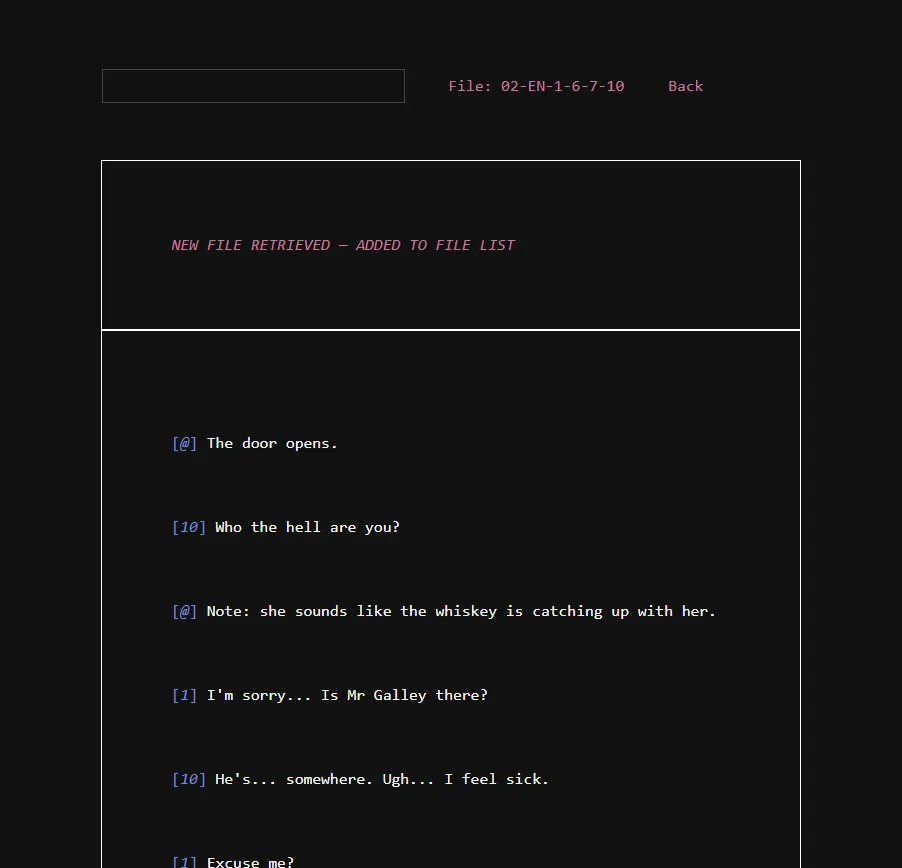
Since this is a mostly text-only game, you’d be forgiven to assume its foremost quality would be its story – it isn’t. Don’t get me wrong, the story is great, in large part thanks to the format of the game; it’s just not the main thing I’d like to talk about here. I’m fascinated by the way the game changes shape, morphs into something different, like a silhouette emerging from the fog, as you play it; and it does so without ever actually changing anything about its UI, gameplay, or any of its structural parts. (Except, arguably, a few minimal features that are ‘revealed’ rather than ‘unlocked’ at various point throughout the experience.) Instead, what it does is overflow out of itself, spilling into a notebook or a database, turning you into an obsessive librarian-detective protagonist, forced to externalize your thoughts and discoveries as they amass into a pile too big for your brain to contain. This is the purest form of the database thriller . I’ll go back to that – but let me introduce the other game first.
0PLAYER, by caveadventure, is “a playable game." (This is its official description.) It has nothing but ‘graphics’. No story, no sound, no gameplay – not in the sense that you expect. In fact, it is delivered to your computer as a zipped folder containing, mainly, one image. No executable. Upon opening the PNG your brain instantly pulls from years of speaking the language of videogames— this is a map. These are puzzles. But what to do? Where to start? Wait— are these the controls?
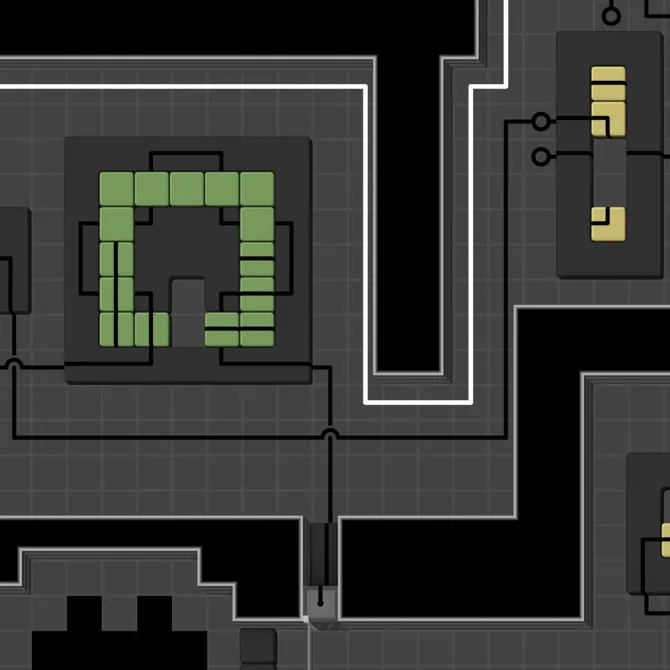
So if this was interactive and I were to click there, something would happen...? And then it would trigger that? And before you know it, you’re playing the game. That is to say, you’re imagining yourself playing another game, which does have gameplay and sound and perhaps even story, and is distributed as an executable; and that act of imagination is you playing this game. But 0PLAYER does not simply lean on this structural twist as an intriguing differentiator; the design goes further, utilizing its nature as a transient ‘thought-thing’ to create epiphanies that could not exist in an interactive form. If the world reacted to your actions, you would simply notice the effects of manipulating the game before having the chance to formulate theories about its rules; you would be a spectator. Instead, here you are a co-designer or perhaps an archaeologist, reverse-engineering the mechanisms of an inert artifact. The unspoken understanding between you the player, and the creators of 0PLAYER, is that the game which emerges in your imagination would work – after all, it is “a playable game” – and based on this faith, you are led to deductions about how the various puzzle pieces should function.
Maybe you see where I’m going with this now, why I wanted to bring up these two seemingly unrelated games in one post. Both Type Help and 0PLAYER are seeds that you unsuspectingly plant in your own brain, where they grow into living organisms with roots that go far deeper than you could have expected. They exist partly on your screen, but mostly beyond it; playing them is done mainly by thinking about them. This isn’t all that noteworthy – it’s what any good puzzle game does. But here the pace of revelations feels so perfectly curated and controlled!
Moment after moment, another firework goes off in your head. You throw your head back, reeling from how satisfying it feels to solve a new mystery – to see the pieces snap perfectly into place. All this without you even pressing a single button. And when you catch your breath and dive back in to take stock of the implications of what you’ve just discovered, the game presents you with a new thing that feels aware of the realization you’ve just had. It’s an asynchronous dialogue with the designers, as if they were looking over your shoulder and asked you with a smug smile, “how clever was that, eh?"
Just like you’re imagining yourself playing an interactive version of 0PLAYER, months or years earlier the developers were imagining you playing the finished version of their prototype, anticipating your progress and acknowledging it in advance. Right as you figure out the whereabouts of a character in Type Help, they are directly referenced in the next dialogue you unlock. This is game design! That’s the whole thing! Every other aspect of the discipline you can think of serves this ultimate purpose: to craft an experience for a player. And here it’s exhibited in its purest form, in two games that took drastically different approaches but similarly eschewed all the bells and whistles that would distract from their core accomplishment: knowing just a second before you what you’re about to understand. And they do it brilliantly.
Anyway, go play them.